
Gyuto vs Santoku: Which Japanese Knife Should You Buy?
As an Amazon Associate, we earn from qualifying purchases. Our recommendations are independent and based on research, not sponsorships.
You’ve decided you want a Japanese knife. Smart move. But now you’re staring at two names that keep coming up — gyuto and santoku — and every list seems to recommend both without explaining which one is actually right for you.
Here’s the honest answer: they’re both excellent all-purpose knives, and most home cooks would be happy with either. But they’re built for different cutting styles, and choosing the one that matches how you actually cook makes all the difference between a knife you reach for every day and one that lives forgotten in a drawer.
This guide breaks down the real differences — blade shape, tip, length, and cutting motion — and gives you a clear recommendation based on your kitchen and your habits. (New to Japanese knives entirely? Start with our guide to what makes Japanese knives different, then come back here to pick your shape.)
The Quick Answer
If you don’t want to read the whole thing:
- Choose a gyuto if you cook a variety of ingredients, handle larger items (roasts, big squash, whole fish), and like a flowing, slightly rocking cutting motion. It’s the more versatile all-rounder.
- Choose a santoku if you cook mostly vegetables and boneless proteins, have a smaller kitchen or cutting board, prefer straight up-and-down chopping, or want a lighter, easy-to-control knife.
Both handle the daily work of a home kitchen. The rest of this article explains why — and helps you feel confident in the choice.
What Is a Gyuto?
The gyuto (牛刀, literally “cow sword”) is Japan’s version of the Western chef’s knife. It emerged during the Meiji era, when Japan was rapidly adopting Western ideas — including a more meat-inclusive diet that demanded a Western-style chef’s knife made with Japanese steel and geometry.
The defining features:
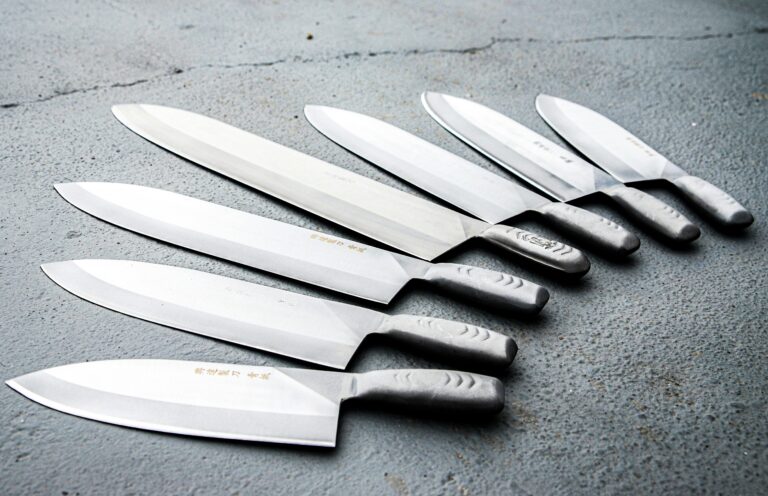
- Length: typically 210–270mm (about 8–10.5 inches), though 180mm versions exist for smaller hands.
- Profile: a curved belly that sweeps up toward the tip, supporting both slicing and a gentle rocking motion.
- Tip: a fine, pointed tip that pierces cleanly and handles detail work like trimming fat or scoring.
- Balance: because it’s longer, a gyuto often feels slightly front-heavy, which actually helps fluid slicing.
In short: the gyuto is the more versatile of the two, especially if you cook larger ingredients or enjoy varied technique.
What Is a Santoku?
The santoku (三徳, “three virtues”) is a more modern knife, developed in 1940s–50s Japan as home cooking shifted toward a more Western, meat-inclusive style. It’s essentially a hybrid — combining the flat profile of the traditional Japanese nakiri (vegetable knife) with the all-purpose ambition of the gyuto.
The name “three virtues” refers to its skill with three ingredients — meat, fish, and vegetables — or, by another reading, three techniques: slicing, dicing, and mincing.
The defining features:
- Length: shorter and more compact, usually 165–180mm (about 6.5–7 inches).
- Profile: a flatter cutting edge that makes full, even contact with the board.
- Tip: a rounded “sheep’s foot” tip — no sharp point, which some cooks find safer and less intimidating.
- Balance: lighter and more evenly balanced, comfortable for repetitive chopping.
- Height: often taller in the blade, giving good knuckle clearance and helping scoop food off the board.
In short: the santoku is compact, controllable, and excellent for everyday vegetable-forward cooking.
The Real Differences That Matter
The marketing specs are easy to list, but four differences actually change how each knife feels in your hand.
1. Blade Profile and Cutting Motion
This is the big one. The gyuto’s curved belly is built for rock chopping — you keep the tip on the board and rock the handle up and down, letting the curve do the work. It also supports long, drawing slices.
The santoku’s flatter edge is built for push cutting and straight up-and-down chopping — the whole edge meets the board at once. Rocking doesn’t really work on a santoku, and that’s by design.
Put simply: a santoku rewards neat, deliberate, straight technique; a gyuto rewards longer, flowing strokes. The knife that matches your natural motion is the one you’ll actually use.
2. The Tip
The gyuto’s pointed tip lets you start a cut cleanly by piercing, and it’s better for precision work — trimming, detailed cuts, getting into tight spots. The santoku’s rounded tip trades that precision for a feeling of safety and stability, which many home cooks appreciate during fast prep.
3. Length and Ingredient Size
The gyuto’s extra length is a genuine advantage with large ingredients — a whole chicken, a big watermelon, a side of salmon, a dense winter squash. One stroke covers more. The santoku’s shorter blade is nimble and easy to control but can feel cramped on big items.
4. Kitchen and Counter Space
A 210mm+ gyuto needs room to move. In a compact kitchen or on a small cutting board, a santoku is simply easier to wield without feeling like you’re fighting the counter.
So Which Should YOU Buy?
Forget which knife is “better” in the abstract — ask which fits your cooking.
Buy a gyuto if:
- You cook a wide range of ingredients, including larger proteins.
- You like a rocking or long-slicing motion.
- You want the single most versatile option and have the counter space.
- You enjoy precise tip work.
Buy a santoku if:
- You cook mostly vegetables and boneless proteins.
- You prefer straight, controlled up-and-down chopping.
- You have a smaller kitchen, smaller hands, or a modest cutting board.
- You want a lighter knife that never feels intimidating.
Still genuinely unsure? Lean gyuto. It’s the more flexible all-rounder, and if you can only own one knife, it covers slightly more ground. But there’s no wrong answer here — both are knives you can cook with happily for years.
A note worth repeating: You do not need both right away. Pick the one that matches how you cook now. Many cooks eventually own both — but that’s a “fell in love with the craft” purchase, not a first-knife necessity.
Our Picks for Each
Whichever shape you choose, stick with a forgiving stainless steel like VG-10 for your first knife and buy from an established maker. Here are solid, widely respected options:
If you choose a gyuto:
- The MAC Professional MTH-80 is an 8-inch gyuto that professional cooks quietly recommend to one another — a genuine “buy once” knife.
- On a tighter budget, the Tojiro DP Gyuto is the classic gateway into Japanese knives: excellent VG-10 steel, honest build, modest price. A shorter 180mm version is easy to control if you’re new.
If you choose a santoku:
- The Tojiro DP Santoku brings the same trusted VG-10 core in a compact, push-cutting package. (It has a decorative Damascus pattern, but remember — the pattern is cosmetic; the steel core is what cuts.)
Whichever you pick, keep it sharp. A simple King 1000/6000 combination whetstone is all most beginners need to maintain a keen edge for years.
How to Care for Either Knife
Both knives ask for the same simple care:
- Hand wash and dry immediately — never the dishwasher.
- Use a wood or soft cutting board; avoid glass, stone, or marble.
- No bones, no frozen food, no twisting.
- Sharpen on whetstones, not pull-through gadgets.
That’s it. A little respect, and either knife will outlast every cheap blade in your drawer.
Conclusion
The gyuto and santoku aren’t rivals so much as two answers to the same question — “what’s the one knife I should cook with?” The gyuto answers with length, a curved belly, and a pointed tip built for versatility and flowing cuts. The santoku answers with a compact, flat, controllable blade built for clean chopping and tight kitchens.
Match the knife to your motion and your space, buy a good one in VG-10, keep it sharp, and you’ll have made the right choice. And if you’re still building your knife knowledge, our guide to what makes Japanese knives different covers the steel, geometry, and care that apply to both.
Frequently Asked Questions
Is a gyuto or santoku better for beginners? Both are beginner-friendly. A santoku is slightly easier to control thanks to its shorter length and rounded tip, while a gyuto is more versatile. If you cook mostly vegetables, start with a santoku; if you want one do-everything knife, choose a gyuto.
Can a santoku do everything a gyuto can? Almost. A santoku handles the vast majority of everyday tasks, but its flat profile makes rocking cuts awkward, and its shorter length is less comfortable with large ingredients like whole chickens or big melons.
What size gyuto or santoku should I get? For a gyuto, 210mm is the classic all-rounder (180mm if you want something more manageable). For a santoku, 165–180mm is standard. Match the blade to your cutting board — it should fit comfortably within the board’s width.
Why does a santoku have a flat edge? The flat edge is designed for push-cutting and straight up-and-down chopping, where the whole edge contacts the board at once. It’s inherited from the traditional Japanese nakiri vegetable knife.
Do I need both a gyuto and a santoku? No. Each is a capable all-purpose knife on its own. Choose the one that matches how you cook. Owning both is a nice luxury later, not a starting requirement.
4 Comments